
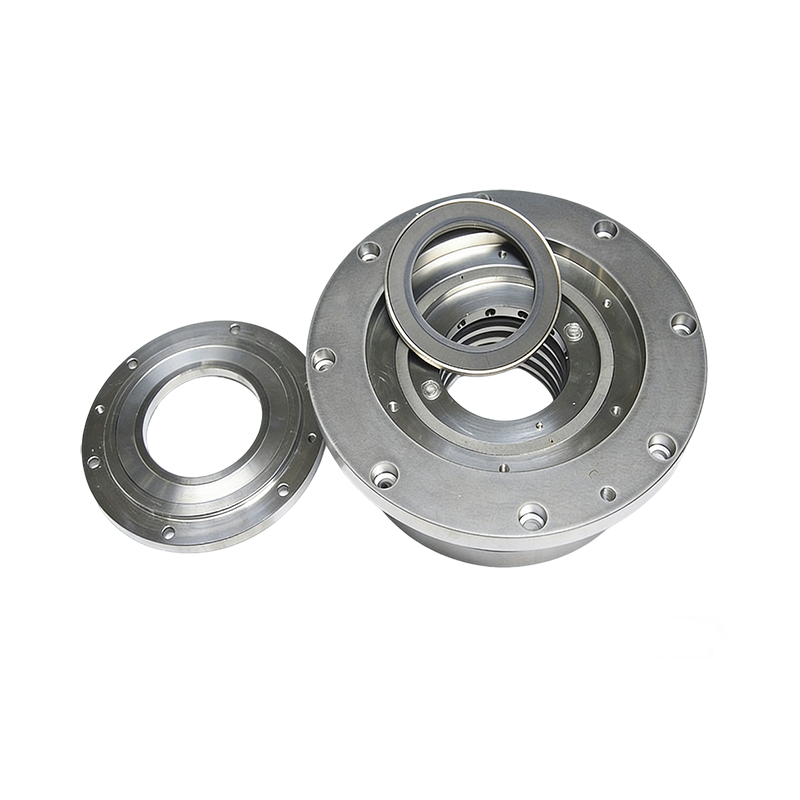
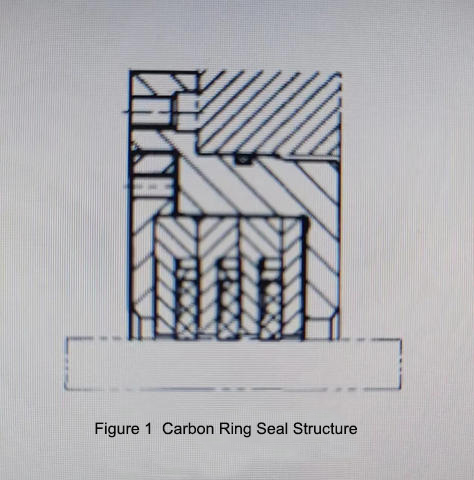
Carbon ring seal is a non-contact sealing device and a type of floating ring seal.The structure is shown in Figure 1.The working principle of carbon ring seal is the same as that of floating ring seal, except that the floating ring is made of non-metallic graphite material.
The structure of a carbon ring seal consists of an annular sealing chamber and an shaft sleeve (the shaft sleeve is optional).At least two annular graphite sealing rings with rectangular cross-sections (also called carbon rings) are installed inside the sealing chamber. Sealing is achieved by controlling the clearance between the inner diameter of the carbon rings and the shaft sleeve.
The radial clearance between the carbon rings and the shaft is typically 3–10 μm.The sealing medium can be air, N₂, CO₂, ammonia, or other gases.
1.Carbon Ring
The carbon ring functions as the rotating ring in a floating ring seal and is made of carbon/graphite material. According to JB/T 9580, carbon ring materials are classified into two categories: mechanical carbon and special graphite.
Mechanical carbon rings are typically impregnated with epoxy resin, phenolic resin, Babbitt alloy, aluminum alloy, copper alloy, etc.
Special graphite rings are mainly impregnated with silicon, providing higher hardness.
Carbon rings shall undergo a hydrostatic pressure test and must show no leakage after 10 minutes. During machining, defects such as cracks, oxidation, delamination, or through-porosity are not permitted.
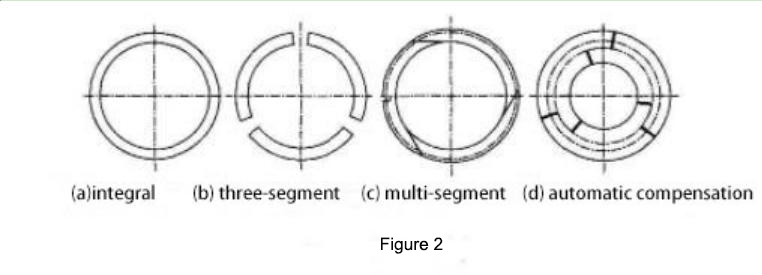
Carbon rings can be manufactured as an integral (one-piece) structure or as a segmented structure. The most common type is the three-segment design.Figure 2(a) shows an integral carbon ring structure, which is installed axially.Figure 2(b) shows a three-segment carbon ring structure. During installation, the segments are clamped together with a spring band and then installed into the sealing chamber.Figure 2(c) shows a multi-segment carbon ring structure. The sealing ring is divided into several segments that form a complete circle. Each segment has an oblique (beveled) cut, and all cuts are made uniformly in the same direction. The tangent of the beveled cut coincides with the circumferential tangent of the inner circle of the sealing ring. This design ensures that, after wear occurs, the carbon ring slides inward along the beveled surfaces toward the shaft sleeve, maintaining a constant sealing clearance.Figure 2(d) shows a gapless carbon ring design with automatic compensation capability. Its working principle is similar to that of Figure 2(c). Both designs achieve automatic compensation through the carbon ring structure arranged in the circumferential groove on the outer diameter of the carbon ring.
The Shore hardness of the carbon ring ranges from 45 to 90 HS.
Under high temperature and high pressure conditions, direct contact between the carbon ring and the rotating shaft may easily lead to fatigue wear of the shaft. Therefore, a shaft sleeve is often installed outside the shaft, and the contact surface of the sleeve is hardened, typically by applying aluminum oxide (Al₂O₃), chromium oxide (Cr₂O₃), or a pure chromium coating.
When the rotational speed and pressure are relatively low, the shaft surface can be directly coated to increase its contact hardness and thereby protect the rotating shaft. The outer surface of the shaft sleeve is usually coated with a wear-resistant layer, generally made of aluminum oxide or chromium oxide.
When carbon ring seals are used to flammable, explosive, toxic, or otherwise hazardous gases, a buffer gas may be introduced into the sealing chamber—typically an inert gas such as nitrogen—to ensure zero gas leakage.
At temperatures as low as –120°C, the self-lubricating property of the carbon ring decreases, which affects its fit with the shaft and consequently reduces the sealing performance.
2.Carbon Ring Machining Method
When fluid passes through a carbon ring seal, sealing is achieved by step-by-step throttling and pressure reduction. Therefore, before assembly, the inner diameter of the carbon ring is manually scraped and lapped to control the clearance between the ring and the main shaft, ensuring the clearance falls within the technically required range.Since carbon rings have a certain hardness, new spare carbon rings are usually supplied with machining allowance. Machining processes are commonly used to replace manual lapping and scraping in order to improve dimensional accuracy and machining efficiency.For integral (one-piece) carbon rings, machining accuracy can be ensured by controlling the machining speed, feed rate, and by enhancing cooling during processing.For segmented carbon rings, special fixtures are required to guarantee machining precision. The dedicated fixture must ensure that the positioning accuracy coincides with the design datum, and that the clamping force corresponds properly to the supporting points.
3.Carbon Ring Radial Centering Device
When the shaft is not in operation, the carbon ring comes into contact with the shaft due to gravity, forming a crescent-shaped gas film clearance beneath the shaft. Once the shaft starts rotating, the pressure generated by the gas film lifts the carbon ring, causing it to move toward a concentric position with the shaft.
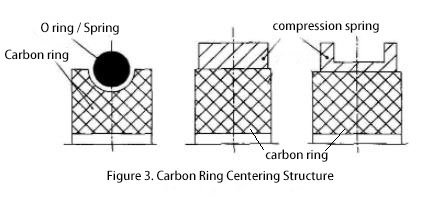
When the radial clearance is small, the hydrodynamic pressure of the fluid is correspondingly low, and the carbon ring’s ability to automatically align with the shaft center is reduced. Therefore, a rubber O-ring is commonly used for positioning. The O-ring does not interfere with the formation of the wedge-shaped gas film, while it reduces the eccentricity of the carbon ring under static conditions and minimizes leakage.
The O-ring may also be replaced by springs, compression springs, or similar elastic elements. Under the action of a compression spring, the carbon ring can maintain its centered position even when the sealing gas pressure decreases.
Grooves are machined on the outer diameter of the carbon ring to facilitate assembly with the O-ring, or the ring may be directly installed with an interference fit to the compression spring. The carbon ring and its centering structure are shown in Figure 3.
4.Carbon Ring Axial Centering Device
During operation, the rotating shaft may experience axial movement (axial runout), which requires the carbon ring to have a certain degree of axial elastic displacement. In engineering applications, the following methods are commonly used for axial positioning:
1.A spring is used for axial installation and positioning.
2.A wave spring with elastic deformation capability is adopted to achieve axial positioning while allowing axial flexibility.
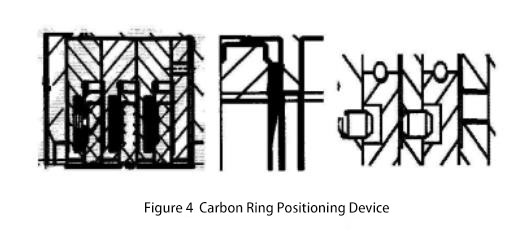
3.When the pressure generated by the gas film exceeds the load borne by the carbon ring, grooves are machined on the end face of the carbon ring and anti-rotation pins are installed to prevent radial rotation of the ring.The structure of the carbon ring positioning device is shown in Figure 4.
5.Applications
Carbon ring seals are widely used due to their simple structure, easy maintenance, and the fact that they do not require complex lubrication or cooling systems. They can effectively prevent contamination of process gases by oil or water. In addition, multiple carbon rings arranged in series can efficiently seal high-pressure gases, making this sealing type highly versatile in industrial applications.
Carbon ring seals are primarily used for petrochemical and metallurgical industries. They are also applied as interstage seals in units such as steam turbines, blowers, generators, compressors, and turbo-machinery.
The applicable operating temperature range is from –120°C to 500°C.