
1. Development History of Honeycomb Seals
Honeycomb seal technology is an advanced sealing solution originally developed by the aerospace industry for high-temperature and high-pressure-differential operating conditions. Honeycomb steam seals have been widely applied in the U.S. Space Shuttle, the Lockheed U-2, and the F-16 Fighting Falcon fighter aircraft.
From 1983 to the early 21st century, developed countries including the United States, Japan, and Germany carried out extensive research on honeycomb seals for steam turbines and filed a large number of patents. Beginning in 1989, Childs D. and other American researchers successively published a series of studies on the stiffness and damping characteristics of honeycomb seals, proposing that honeycomb seals can significantly improve the rotordynamic performance of steam turbines.
2.Structure and Principle of Honeycomb Seals
2.1 Structure
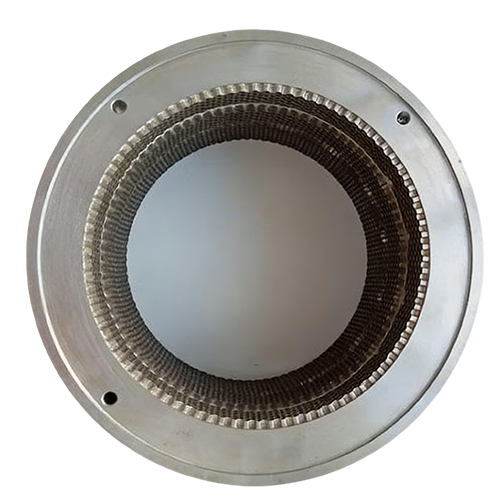
A honeycomb seal refers to a sealing ring whose inner surface is composed of regularly arranged hexagonal honeycomb cells forming a honeycomb strip.
The honeycomb strip is manufactured from a thin sheet of nickel-based high-temperature alloy (Hastelloy X) with a thickness of only 0.05–0.10 mm. The sheet is processed on specialized forming equipment to produce a hexagonal grid structure and is then assembled through a special welding process.
According to the size of the sealing ring, the honeycomb strip is fabricated to the required dimensions and then attached to the base sealing ring. Using vacuum brazing technology in a vacuum brazing furnace, the honeycomb strip is brazed onto the parent sealing ring, thereby forming the honeycomb seal structure.
2.2 Principle
The sealing mechanism of a honeycomb seal lies in its unique cellular structure. The honeycomb cavities generate strong vortices and flow barriers when the working medium passes through them. These vortices create significant damping effects, which effectively restrict the leakage of the working fluid and improve sealing performance.
Experimental results show that for honeycomb seals with a depth of 3.0 mm and honeycomb cell sizes (distance across opposite sides of the hexagon) of 3.2 mm, 1.6 mm, and 0.8 mm, the seal with a 1.6 mm cell size achieves the best sealing performance under different rotational speeds and pressure ratios.
The relationship between the honeycomb cell size and leakage is not linear. When the ratio of the honeycomb cell distance across flats to the honeycomb depth is approximately 0.52, the leakage rate tends to be relatively low.
In addition, under the same inlet conditions, the smaller the clearance, the larger the angle between the airflow entering the honeycomb cavity and the horizontal plane. This results in larger vortex volumes, with the vortex center located closer to the bottom surface of the cavity.
3.Advantages of Honeycomb Seals
1) Wear Resistance, Rotor Protection, High Pressure Capability, and Excellent Sealing Performance
The honeycomb wall is extremely thin. If rubbing contact occurs between the seal and the rotor, the honeycomb material wears first, thereby protecting the rotor from damage.
The honeycomb features a regular hexagonal grid structure with high structural strength, enabling it to withstand very high pressures. Even under large pressure differentials, there is no need to increase the seal size. In both axial and circumferential directions, the honeycomb structure generates strong vortices and flow barriers, significantly enhancing shaft-end sealing performance.
2) Long Service Life
The honeycomb structure achieves maximum strength with minimal material mass. It is resistant to wear that would otherwise enlarge the sealing clearance, and the structure does not collapse or deform easily. As a result, the small installation clearance can be maintained for a long period, leading to an extended service life.
Tests have shown that the wear life of honeycomb seals is approximately 2.5 times that of ferritic labyrinth steam seals.
3) Reduction of Subsynchronous Vibration
Honeycomb seals provide sufficient damping, particularly forged honeycomb seals, which are especially effective in demanding operating conditions. When a unit passes through critical speeds, they can effectively suppress airflow-induced rotor excitation and ensure the stable operation of the compressor.
Experience from the Space Shuttle main engine high-pressure liquid oxygen turbopump has demonstrated that replacing interstage labyrinth seals with honeycomb seals can eliminate rotor instability and significantly reduce subsynchronous vibration levels.
Experimental studies further indicate that the optimal vibration reduction performance is achieved with a sealing configuration in which the stator uses a honeycomb seal and the rotor is equipped with labyrinth.
4) Dehumidification Function
When installed at the tip seal of the last-stage blades in the low-pressure cylinder of a steam turbine, honeycomb seals not only improve efficiency but also help remove moisture.
The honeycomb cells can capture and retain water droplets, effectively reducing moisture content, protecting moving blades from water erosion, and extending blade service life.