
A mechanical seal mainly consists of one or several pairs of rotating rings and stationary rings, which together form a pair of friction surfaces. Its working principle is shown in the figure 1. Through elastic components, such as springs or bellows, together with the pressure of the sealing fluid, an appropriate closing force is generated between the contact surfaces (seal faces) of the rotating ring and the stationary ring. This force allows the two seal faces to remain in close contact with each other.
Under this tightly fitted condition, only an extremely thin liquid film is maintained between the seal faces. It is this thin liquid film that performs the sealing function. At the same time, it also performs the important functions of lubrication and pressure balancing.
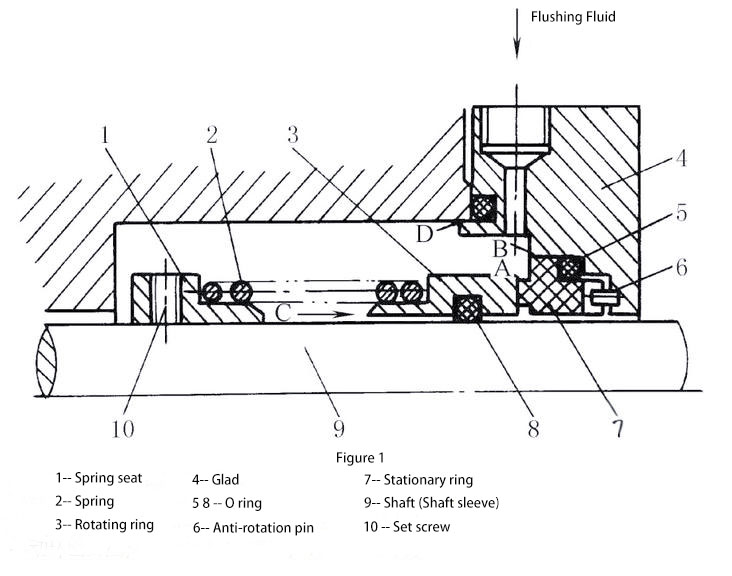
When the shaft (9) begins to rotate, the set screw (10) works together with the spring (2) to drive the rotating ring (3) to rotate. The anti-rotation pin (6) is fixed on the stationary gland (4), and its function is to prevent the stationary ring (7) from rotating.
When wear occurs on the sealing faces, the rotating ring (3) and its secondary seal (8) move slightly in the axial direction under the force of the spring (2), thereby compensating for the wear.
Therefore, the ring that has the ability to compensate for wear is called the compensating ring, while the stationary ring, which does not possess this compensating capability, is referred to as the non-compensating ring.
It should be noted that, through proper structural design, the role of the compensating ring can be performed either by the rotating ring or by the stationary ring. The assembly composed of the compensating ring, elastic elements, and secondary seals is called the compensating ring assembly.
In the structure of a mechanical seal, there are usually four sealing locations or passages, as A–D in Figure 1.
Among them, A is the face seal, which is also commonly referred to as the primary seal. B is the seal between the stationary ring (7) and the end face of the gland (4). C is the mating surface seal between the rotating ring (3) and the shaft (or shaft sleeve) (9). Because it can maintain sealing while moving axially with the compensating ring, it is also called the secondary seal. D is the seal between the gland and the end face of the pump casing.
It should be noted that the static sealing design at locations B–D makes them less to leakage under normal conditions. As for the face seal at A, although it is a relatively rotating sealing surface, it can also effectively reduce leakage when properly designed.