
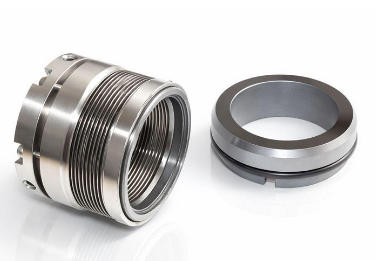
As a primary protective component in fluid equipment, the selection of metal bellows mechanical seals directly affects operational stability and safety. Compared with conventional elastomer seals, metal bellows offer superior high-temperature resistance, corrosion resistance, and compensation capability, making them widely used in high-risk industries such as petrochemicals, nuclear power, and pharmaceuticals. However, the complexity of real operating conditions requires a multi-dimensional evaluation. The following provides a technical analysis from five key aspects:
1. Medium Properties and Material Compatibility
The chemical composition, corrosiveness, solid content, and viscosity of the medium are the primary basis for selection.
For highly corrosive media (e.g., concentrated sulfuric acid or hydrochloric acid), bellows materials such as Hastelloy C-276 or titanium alloys are preferred due to their excellent resistance to pitting corrosion from ions like Cl⁻ and SO₄²⁻.
When the medium contains solid particles (e.g., slurry or coal chemical black water), tungsten carbide or hard alloys should be used for seal faces, with surface treatments such as chromium plating or ceramic coatings to enhance wear resistance.
It is also important to note that high-temperature oily media may cause material swelling. In such cases, materials with low thermal expansion coefficients, such as Inconel 718, combined with graphite impregnation, can improve lubrication performance.
2. Operating Conditions and Structural Design Optimization
Temperature and pressure fluctuations significantly affect the elastic modulus and fatigue life of bellows.
Under high-temperature conditions (>400°C), a multi-layer thin-wall bellows design is recommended. Increasing the number of convolutions helps distribute thermal stress, while high-temperature alloys such as Inconel X-750 improve creep resistance.
For high-frequency pressure shocks (e.g., reciprocating pumps), bellows with damping grooves can be designed to reduce instantaneous pressure impact on seal faces through hydraulic buffering.
In vacuum conditions, special attention must be paid to axial stiffness to prevent instability and deformation. This can be addressed by increasing wall thickness or adopting semi-rigid support structures.
3. Equipment Characteristics and Installation Adaptability
Equipment vibration amplitude, shaft runout, and installation space directly influence seal applicability.
For high-vibration equipment (e.g., compressors and pumps), self-adaptive bellows seals with axial compensation up to ±2 mm are recommended. A low spring rate design can help absorb vibration effects.
In space-constrained applications (e.g., compact reactors), compact welded bellows seals can reduce axial length by up to 30% while maintaining sufficient compression travel.
Special attention should also be given to shaft sleeve surface roughness, which should be controlled below Ra 0.8 μm to avoid damaging the bellows.
4. Auxiliary Systems and Long-Term Maintenance
Cooling and flushing systems are critical to stable seal operation.
For high-temperature media, a dual-channel cooling system is recommended. Spiral cooling grooves can effectively reduce bellows temperature to within allowable limits.
Flushing schemes should preferably adopt API Plan 62, with a flow rate 5–10 times the leakage rate of the medium, and a 50 μm filter to prevent particle deposition.
From a maintenance perspective, it is recommended to disassemble and inspect the bellows every 2,000 operating hours for fatigue cracks. Ultrasonic testing can detect micro-defects. Spare seals should be stored in a nitrogen-filled environment to prevent oxidation and corrosion.
5. Balance Between Cost and Reliability
Seal selection must balance initial investment and lifecycle cost.
Although fully welded bellows have higher manufacturing costs, their leakage risk is significantly lower than flange-type structures, making them ideal for toxic or hazardous media.
For intermittent operation, repairable hard-faced bellows can be used. Local wear can be restored through welding, reducing replacement frequency and overall cost.
Conclusion
The selection of metal bellows mechanical seals requires an integrated technical framework encompassing materials, structure, operating conditions, and maintenance.
With the advancement of digital technologies, virtual simulation can be used to predict seal failure risks in advance, enabling precise selection and predictive maintenance. Only through the integration of engineering expertise and management strategies can the full performance advantages of metal bellows seals be realized, ensuring the safety and reliability of industrial equipment.