
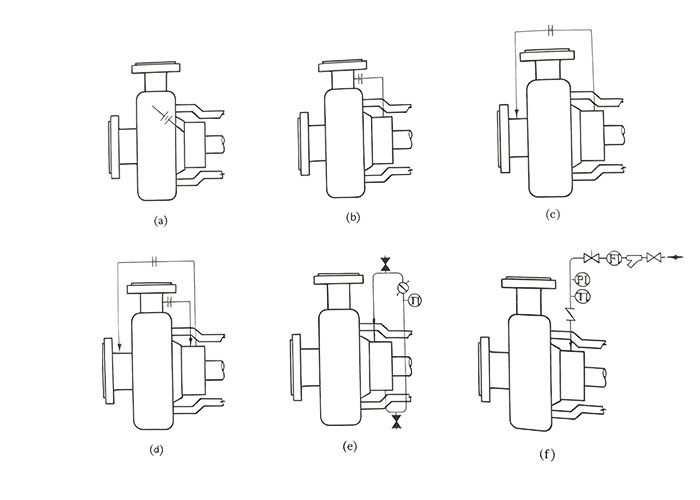
Mechanical seal flushing methods can generally be classified, according to the flushing direction and the source of the flushing fluid, into the following types: positive direct self-flushing, positive external flushing, reverse external self-flushing, through flushing, circulating self-flushing, and external flushing.
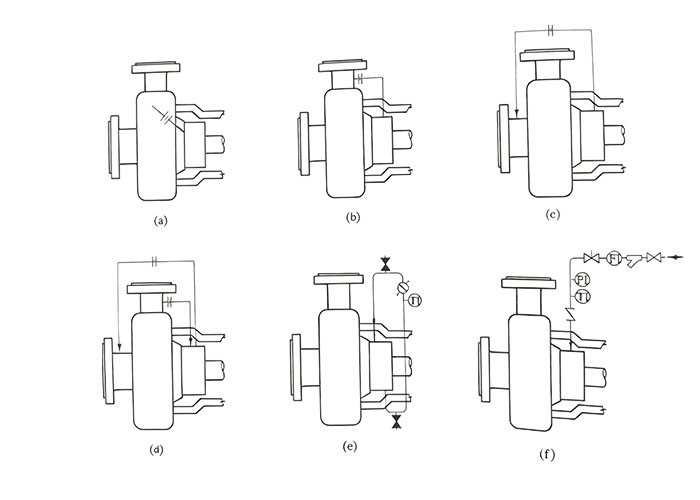
Positive direct self-flushing(a)
The sealed medium is introduced from the pump chamber near the pump discharge directly into the seal chamber for flushing.
Positive external self-flushing(b)
The sealed medium is led from the seal chamber through an external pipeline to the pump suction side.
Reverse external self-flushing(c)
The sealed medium flows from the seal chamber through an external pipeline back to the pump suction side in the reverse direction.
Through self-flushing(d)
This method combines positive external self-flushing and reverse external flushing. The sealed medium flows from the pump discharge into an external pipeline, enters the seal chamber, and then returns to the pump suction side through another pipeline.
Circulating self-flushing(e)
The sealed medium circulates within the seal chamber. Driven by the pumping ring, the fluid is discharged from the seal chamber, cooled externally, and then returned to the seal chamber.
External flushing(f)
A pressurized fluid from an external system is introduced into the seal chamber. This fluid should be compatible with the process medium and must not adversely affect the process operation.
External flushing can be divided into circulating and non-circulating types.
When the external flushing fluid pressure is higher than the sealed medium pressure, it is called a barrier fluid.
When the external flushing fluid pressure is lower than the sealed medium pressure, it is called a buffer fluid or quench fluid.
All of the above flushing methods utilize pressure differentials to promote fluid flow and achieve the flushing effect. The most suitable method should be selected according to equipment characteristics, medium properties, operating temperature, and other process conditions.
For single-stage centrifugal pumps, when the seal chamber pressure is lower than the pump discharge pressure but higher than the suction pressure, either positive self-flushing or reverse self-flushing may be used. When the seal chamber pressure is only slightly higher than the suction pressure, reverse self-flushing becomes less effective, and through self-flushing may be adopted. When the seal chamber pressure is close to both the suction and discharge pressures, external flushing is generally used.
For multistage centrifugal pumps, the seal chamber is usually connected to the pump suction side or the first-stage discharge side to achieve the flushing purpose.