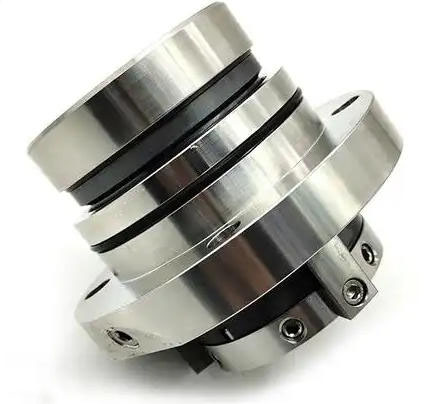
| Performance Comparison Between Tandem Dry Gas Seals and Tandem Mechanical Seals |
| | Tandem Mechanical Seal | Tandem Dry Gas Seal |
| API682 Standard | Plan11+52 | Plan11+72+76 or 75 |
| Auxiliary system configuration cost | Three pressure switches + seal oil tank (pressure vessel) | Two pressure switches and selected valves and piping fittings |
| Conclusion: The auxiliary system cost of Plan 11 + 52 is higher than that of Plan 11 + 72 + 76, and the current total cost is higher than that of dry gas seals. |
| Operating cost | It consumes more seal oil and desalinated water, with relatively higher power consumption. | It consumes only a minimal amount of nitrogen, and its power consumption is approximately 5% of that of mechanical seals. |
| Conclusion: Dry gas seals have lower overall consumption. |
| Routine maintenance | Manual inspection and manual topping up of seal oil | Automatic nitrogen supply from the pipeline, maintenance-free. |
| Conclusion: The routine maintenance workload of tandem mechanical seals is greater than that of dry gas seals. |
| Maintenance and overhaul | Seal failure may cause oil contamination, necessitating oil replacement or replenishment, which increases maintenance workload and leads to poor on-site environmental conditions. | By shutting off the gas supply, the seal can be easily dismantled and replaced. The operation is simple and does not cause contamination to the site environment. |
| Conclusion: The replacement procedure for tandem mechanical seals is more complex than that for dry gas seals, and the on-site environment conditions are relatively poorer. |
| On-site environment | Seal oil can permeate through the sealing faces to the outside, resulting in poor environmental conditions. | Only a small amount of nitrogen leaks directly into the atmosphere, resulting in negligible impact on the on-site environment. |
| Conclusion: Equipment using dry gas seals remains clean and free of oil contamination, and no routine cleaning is required. |
| Safe and reliable | In the event of primary seal failure, the secondary seal can operate for over 8 hours without sustaining damage. | In the event of primary seal failure, the secondary seal can operate for over 8 hours without sustaining damage, while nitrogen protection provides enhanced safety. |
| Conclusion: Both systems provide high safety and reliability, with seal leakage monitored via remote and on-site monitoring systems. |
| Service life | To achieve a service life of 25,000 hours, higher-grade sealing materials are required, which increases the cost. | Standard materials can also achieve a service life of 25,000 hours. |